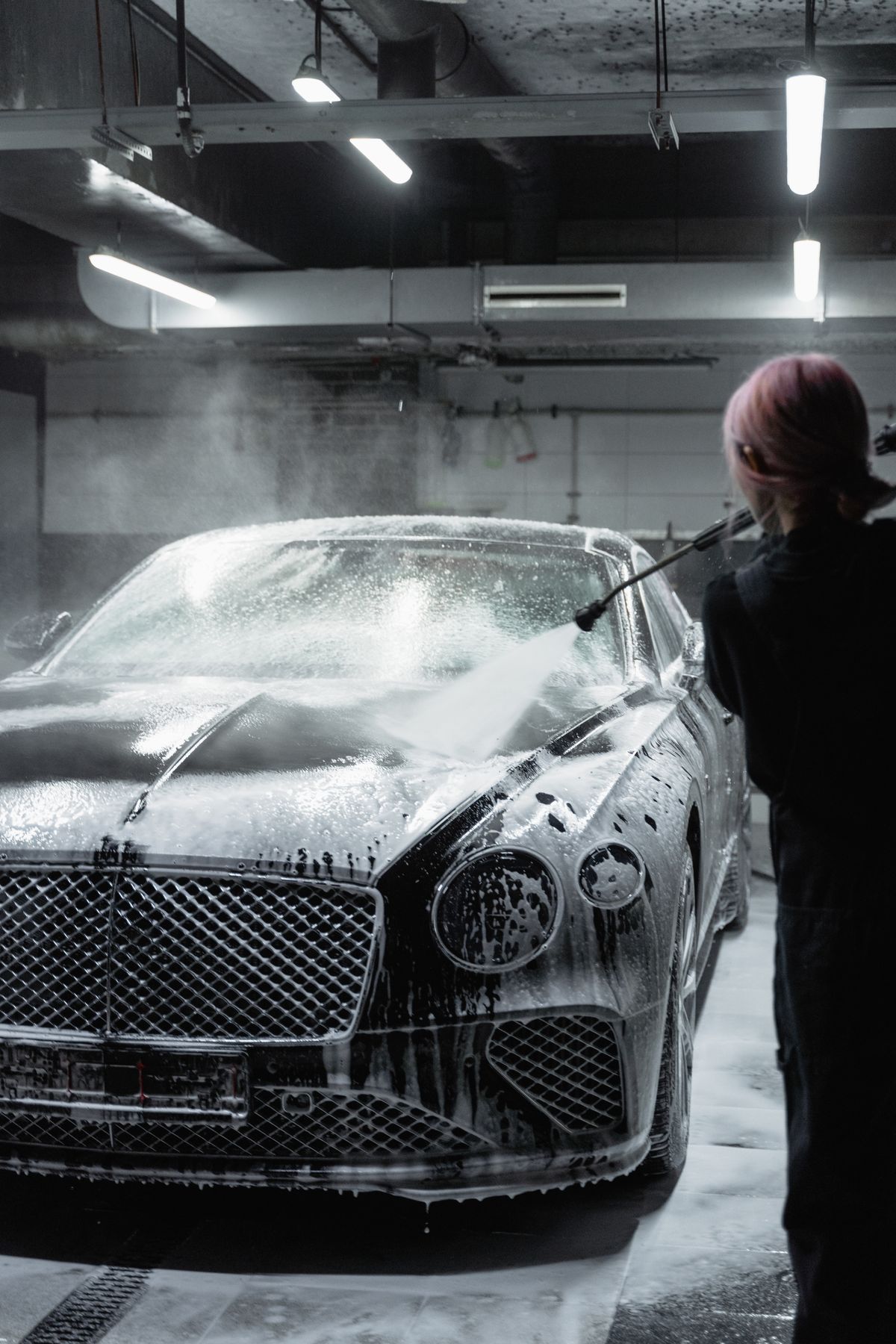
You only see them on a sunny day.
Buster's Detailing is Danny, working on his own out of Halifax. He brings the water, the power and the trade products to your drive or your workplace.
This is a bonnet under an inspection light — the only place swirl marks are honest. Scroll, and the four stages of a proper job happen to it in the order they have to happen.
They are not in the paint. They are in the lacquer.
Fine circular scratches in the clear coat, put there a few at a time by sponges, brushes, dirty mitts and drive-through brushes. Each wash adds a few more.
Under a cloudy sky they are invisible. Under one bright light they turn into a halo, which is why a car that looked fine on the drive looks tired in a car park in June.
Polishing dirty paint just grinds the dirt in.
Tar spots, iron fallout off brake dust, and bonded grime that a wash will not shift. They sit proud of the lacquer, and a polishing pad will drag every one of them across the panel.
So they come off first, chemically and with a clay bar, before anything with a machine goes near it. It is the stage people skip and the reason the stage after it goes wrong.
A cut takes the lacquer down to the bottom of the scratch.
That is all a machine polish is: removing a few microns of clear coat until the floor of the swirl is the new surface. Watch the halo close up into a single clean highlight.
There is a finite amount of lacquer, which is why it is a single-stage cut on most cars rather than something to have done every year. It shows most on dark paint.
Then a hard layer over paint that has been prepared for it.
A ceramic coating goes on last, and only onto corrected paint — put it over swirls and you have sealed the swirls in for two years.
Water stops wetting the surface and sheets straight off it instead, which is most of why the next wash takes half the time. A wax does a gentler version of the same thing for months rather than years.