Some of this is not your decision to make.
A tree in your own garden can still be one you are not allowed to touch, and there are months of the year when the work has to wait. Both are worth knowing before you book anybody, including us.
PRESERVATION ORDERS AND CONSERVATION AREAS
Cutting a protected tree is an offence.
And it is the owner who answers for it, not the contractor. Three questions narrow down where you stand — though the only answer that counts comes from Calderdale Council, and we ask them before a saw goes anywhere near it.
Nobody can answer this from a garden.
THE OTHER THING THAT DECIDES WHEN
Birds nest from roughly March to August.
An active nest stops work on that tree until the young have flown — not as a courtesy, but because it is against the law to damage one. It is the single most common reason a job that was agreed in April happens in October.
The nesting season is not a hard date in a diary; it depends on the birds and on the weather. What it means in practice is that anything big is easier arranged for the back half of the year, and that a tree gets looked at before it gets cut whatever the month.
Six weeks' notice
Trees in a conservation area need six weeks' notice to Calderdale Council before anything happens. Not a form to post afterwards — six weeks before.
Consent, not notice
A preservation order is stronger: the work needs consent, and the application goes in and the job waits until there is an answer.
Storm damage is different
A split limb hanging over a road, a drive or a neighbour's roof gets dealt with before anything else on the list. Ring rather than fill anything in.
We check, you are responsible
The council gets asked either way. But the duty sits with whoever owns the tree, which is why it is worth knowing rather than assuming.
WHAT WE DO
Start with what is wrong, not what it is called.
Nobody rings up asking for a crown reduction. They ring because the tree is too big, or it is dropping branches on the car. The right job is usually underneath the complaint.
TOO BIG
Crown reduction
Taking height and spread off while keeping the shape, so the tree stays a tree. Usually solves the problem people wanted felling for.
BLOCKING THE LIGHT
Crown thinning and lifting
Letting light through the canopy, or raising the lower branches so you can walk and mow underneath.
DROPPING BITS
Deadwooding
Dead limbs taken out before they fall on a car or a greenhouse. A small job, and the one most worth doing early.
ALREADY COME DOWN
Storm damage
A split limb hanging over a road, a drive or a neighbour's roof. These jump the queue.
HAS TO COME OUT
Felling
Taken down in sections where there is no room to drop it whole. Often the last resort rather than the first — ask before you assume.
OVER THE BOUNDARY
Hedges
Cut, shaped and reduced, including the tall conifer hedges nobody can reach. Clippings taken away.
STUMP LEFT BEHIND
Stump grinding
Ground out below ground level so you can turf, pave or plant over the top of it.
YOU DO NOT KNOW
Is it dying?
Come and look before you decide. Plenty of trees that look finished in February are fine in May, and some that look healthy are hollow.
WHY THE SAME TREE IS TWO DIFFERENT PRICES
Two trees, two very different days.
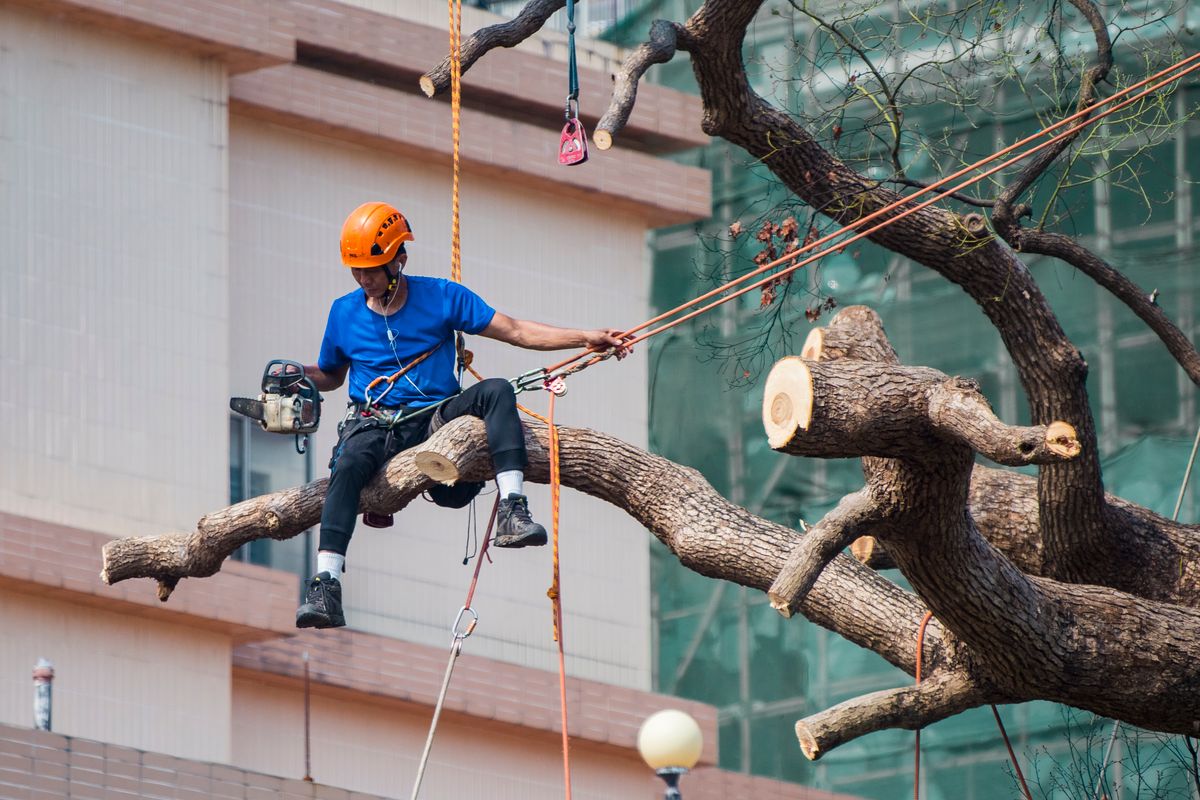
A sycamore in an open field comes down in a morning. The same tree over a conservatory, with the only way in through the house, is a rope job that takes two men and most of a week's patience.
So the price follows the access, the height and what is sitting underneath it. Send a photo with something in it for scale — a wheelie bin or a back door — and you will get a straight answer rather than a range.
Where the timber ends up is part of it too. Brash goes through the chipper, and the logs can be stacked by the shed if you burn them or taken away if you do not.
ASK ABOUT A TREE
Ring and describe it.
Anything hanging over a road or a roof is a phone call, not a form. Everything else, send the rough height, how close it is to the house, and a photograph with something in it for scale.
Covering Sowerby Bridge, Halifax, Hebden Bridge, Elland, Ripponden and the villages between.
Before anything comes down, check with Calderdale Council whether the tree has a preservation order or sits in a conservation area. We check too, but the responsibility rests with whoever owns it.